
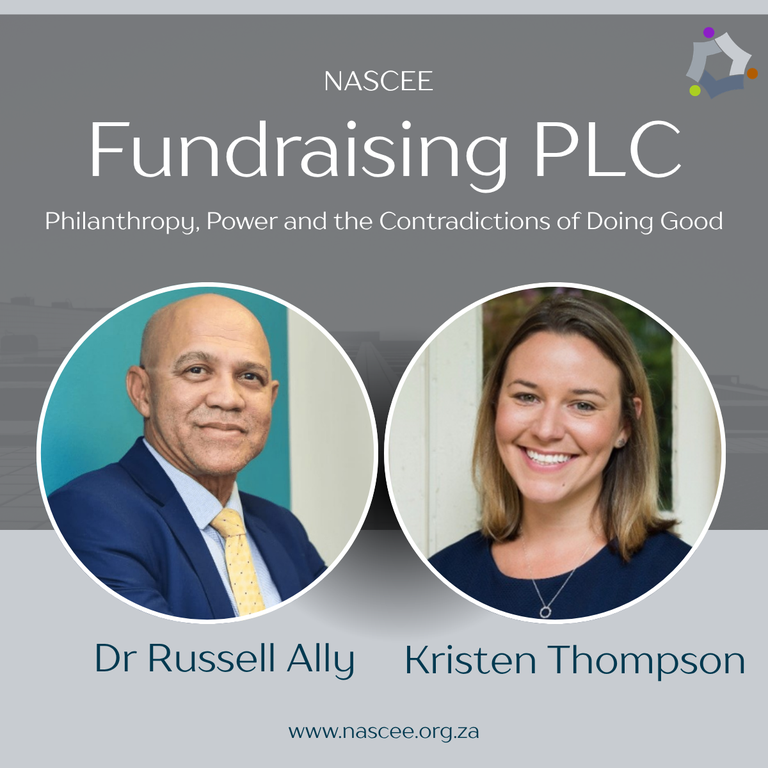
NASCEE Fundraising Professional Learning Community Masterclass
Philanthropy, Power and the Contradictions of Doing Good - Reflections from a career on both sides of the table
Our recent Fundraising Professional Learning Community Masterclass with Dr. Russell Ally, whose extensive experience both as grant-maker and resource mobiliser, offered a thought-provoking exploration of the realities of philanthropy. Through honest reflection and practical insight, he challenged us to look beyond the language of generosity and impact to consider the power dynamics that shape funding decisions.
Opening with the observation that "power easily masquerades as wisdom," Dr. Ally reflected on his own journey from grant-maker to fundraiser and how dramatically the power dynamic shifted when he moved from distributing resources to seeking them. His reflections resonated deeply with participants, many of whom recognised the frustration of working in organisations with meaningful solutions but struggling to access the networks, language, and relationships that philanthropy often rewards.
The discussion also explored the realities facing the sector today, including the prevalence of short-term funding for long-term social challenges, increasing pressure to demonstrate measurable results in complex environments, and the growing need for collaboration across civil society. Dr. Ally reminded us, "social change is messy," and not everything that matters can be measured. While accountability remains essential, he encouraged both funders and organisations to recognise that the slow work of strengthening communities, building trust, and creating lasting change cannot always be captured in spreadsheets and quarterly reports. He further reminded participants that fundraising is both intellectually and emotionally demanding work and repeatedly requires resilience, strategic empathy, emotional discipline and tolerance for rejection.
A key takeaway was the need to shift our mindset from fundraising to resource mobilisation. Rather than defining organisations by what they lack, Dr. Ally encouraged participants to acknowledge and share the value they create within civil society and the trust they build in communities. Financial resources are only one piece of the puzzle, with governance, partnerships, expertise, credibility, networks, and community trust all being resources that contribute to sustainable impact.
Dr. Ally challenged organisations to remain deeply rooted in the communities they serve, reminding us that "your most important resources are the communities that you are working with." Ultimately, he argued, the purpose of civil society is not organisational survival, but community agency. He further reflected, "within civil society, we must always think of working ourselves out of a job." The goal is not dependency, whether on our own organisations or on funders, but to build the capacity and resilience of communities to shape their own futures. When organisations lose sight of this, the relationship between funder and fundraiser can begin to overshadow the very purpose of the work.
For participants newer to fundraising, Dr. Ally offered practical advice: invest in strong governance, build engaged boards that open doors and provide strategic oversight, learn continuously from peers, and adapt ideas to your own context rather than simply importing global trends. Excellence in the fundamentals, he suggested, is often more valuable than pursuing innovation for its own sake.
The session concluded on an optimistic note. While philanthropy is inevitably shaped by power and contradiction, Dr. Ally reminded us that "meaningful philanthropy is not charity flowing downward, but the coming together of mutually reinforcing assets" from both sides of the relationship. He left participants with a final reflection that captured the spirit of the conversation, The perfect is the enemy of the good." By approaching philanthropy with integrity, intentionality, and a commitment to genuine partnership, we move closer to the lasting social change we all seek.
As he concluded:
"Because philanthropy, at its best, is not simply about money moving from one place to another. It is about how human beings negotiate power, hope, obligation, dignity and trust even within deeply unequal societies. While that remains difficult and imperfect work, it also remains profoundly important work." - Dr. Russell Ally